
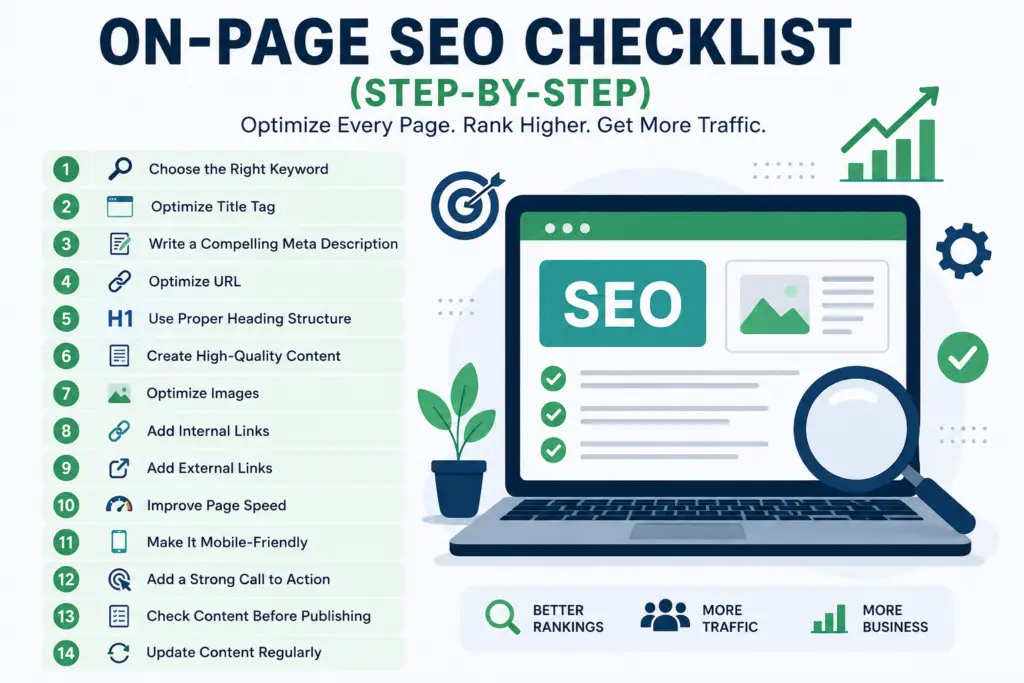
If you want your website to rank higher on Google, publishing content is not enough. You also need to make sure every page is properly optimized for search engines and users. This is where an On-Page SEO Checklist (Step-by-Step) becomes useful.
On-page SEO means optimizing the elements that are present on your website, such as titles, headings, URLs, content, images, internal links, and meta descriptions. A well-optimized page can help search engines understand your content and can also give visitors a better experience.
For business owners and startup owners in Ghaziabad, on-page SEO is especially important. Whether you run a local service business, e-commerce store, startup, or professional company, following a proper On-Page SEO Checklist (Step-by-Step) can help you build a stronger search presence.
At Aseer Growth, we believe SEO should be simple, useful, and focused on real business results. So, let’s go through the checklist step by step.
1. Choose the Right Primary Keyword
The first step in any On-Page SEO Checklist (Step-by-Step) is keyword research.
Your primary keyword should match what your target audience is actually searching for. Do not choose a keyword only because it has high search volume. Think about search intent, competition, and whether the keyword can bring potential customers to your business.
For example, a digital marketing agency in Ghaziabad may target keywords related to SEO services, digital marketing services, PPC, or local SEO.
Use your primary keyword naturally in the content. Avoid repeating it unnecessarily because keyword stuffing can make your content difficult to read.
2. Create an SEO-Friendly Title
Your page title is one of the first things users and search engines see.
As part of your On-Page SEO Checklist (Step-by-Step), create a clear and attractive title that explains what the page is about.
Try to include your primary keyword naturally near the beginning of the title when possible. Keep the title useful rather than writing something only for search engines.
For example:
Good: On-Page SEO Checklist (Step-by-Step) for Business Owners
This tells the reader exactly what they can expect from the article.
3. Write a Useful Meta Description
The next important item in your On-Page SEO Checklist (Step-by-Step) is the meta description.
A meta description gives users a short summary of your page in search results. While it is not a direct ranking factor, a clear description can encourage people to click on your result.
Explain what the page offers and give readers a reason to visit. Keep the language simple and relevant to the search query.
For example, you can explain that the guide covers titles, headings, URLs, content, images, internal links, and other important SEO elements.
4. Optimize Your URL
A clean URL is easier for users and search engines to understand.
Your On-Page SEO Checklist (Step-by-Step) should always include URL optimization.
A good URL should be:
- Short and easy to read
- Relevant to the page
- Free from unnecessary numbers or symbols
- Related to the main topic
- Easy to remember
For example:
Good: example.com/on-page-seo-checklist
Avoid URLs such as:
Bad: example.com/page?id=45892&category=seo
A simple URL gives both users and search engines a better idea of the page topic.
5. Use Proper Heading Structure
Headings make your content easier to read and understand.
When following an On-Page SEO Checklist (Step-by-Step), use one clear H1 heading for the main topic. Then use H2 headings for major sections and H3 headings for supporting topics.
Do not add headings only to insert keywords. Every heading should help the reader understand the information that follows.
A clear structure also makes long articles easier to scan, especially for busy business owners.
6. Create Helpful and Original Content
Content is one of the most important parts of on-page SEO.
Your On-Page SEO Checklist (Step-by-Step) should focus on creating content that answers the user’s actual question. Do not write content simply to reach a particular word count.
Good SEO content should:
- Answer important questions
- Provide practical information
- Be easy to understand
- Use real examples where useful
- Match search intent
- Avoid unnecessary repetition
For business websites, include information that helps customers make decisions. Explain your services, benefits, processes, and solutions clearly.
Experience also matters. If you have worked on SEO campaigns or managed websites, adding practical examples and lessons can make the content more trustworthy.
7. Place Keywords Naturally
Keyword placement is another important part of an On-Page SEO Checklist (Step-by-Step).
Your primary keyword can appear in important areas such as:
- Page title
- H1 heading
- Introduction
- Relevant H2 headings
- Main content
- URL, where appropriate
- Image alt text, where natural
- Conclusion
However, do not force the keyword into every paragraph.
Google is becoming better at understanding topics and context. Use related words and natural language instead of repeating the same phrase again and again.
8. Optimize Your Images
Images can improve the user experience, but large and unoptimized images can slow down your website.
Include image optimization in your On-Page SEO Checklist (Step-by-Step).
Before uploading an image, compress it and use an appropriate file format. Give the image a descriptive file name instead of something generic like IMG1234.jpg.
You should also use meaningful alt text. Alt text helps explain the image to users who cannot see it and helps search engines understand the image.
For example:
Poor alt text: image1
Better alt text: Business owner reviewing an SEO performance report
9. Add Internal Links
Internal linking is often overlooked by new website owners.
A strong On-Page SEO Checklist (Step-by-Step) should include links between relevant pages on your website.
For example, a blog about on-page SEO can link to your SEO service page, local SEO guide, technical SEO article, or related blog posts.
Internal links can help users discover more useful information and help search engines understand the relationship between different pages on your website.
Use descriptive anchor text instead of generic phrases like “click here.”
10. Add External Links When Useful
External links can also improve the quality of your content when used correctly.
If you mention research, statistics, official guidelines, or important industry information, linking to a reliable source can help support your claims.
Do not add external links just for the sake of adding them. Focus on trusted and relevant sources.
For business owners, this is an important part of building credibility and demonstrating experience and knowledge.
11. Improve Page Speed and Mobile Experience
A technically good page can still perform poorly if it is slow or difficult to use.
Your On-Page SEO Checklist (Step-by-Step) should therefore include checking page speed and mobile usability.
Make sure your website:
- Loads quickly
- Works properly on smartphones
- Has readable text
- Uses buttons that are easy to tap
- Does not have distracting pop-ups
- Provides simple navigation
Many customers search for local businesses from their phones. If your website does not work well on mobile devices, you may lose potential customers.
12. Add a Strong Call to Action
SEO should not only bring traffic. It should help your business generate results.
After completing your On-Page SEO Checklist (Step-by-Step), check whether visitors know what to do next.
Depending on your business, your CTA could ask visitors to:
- Request a quote
- Book a consultation
- Call your business
- Contact your team
- Buy a product
- Download a resource
Keep the CTA clear and relevant to the page.
13. Check Your Content Before Publishing
Before publishing, go through your On-Page SEO Checklist (Step-by-Step) one final time.
Check your spelling, grammar, headings, keyword placement, links, images, URL, title, and meta description.
Also read the article like a customer. Ask yourself: “Does this page actually answer my question?”
If the answer is yes, your content is likely providing real value.
14. Keep Updating Important Pages
SEO is not a one-time task.
A good On-Page SEO Checklist (Step-by-Step) should also include regular content updates. Search trends, customer needs, competitors, and industry information can change over time.
Review your important pages regularly. Update outdated information, improve weak sections, add new internal links, and remove information that is no longer useful.
For businesses targeting Ghaziabad, you can also keep local information, services, contact details, and location-related content accurate.
Final Thoughts
On-page SEO does not have to be complicated. By following this On-Page SEO Checklist (Step-by-Step), business owners and startup owners can systematically improve their website and create a better experience for visitors.
Start with the basics: choose the right keyword, create a useful title, optimize your URL, write helpful content, improve headings, add internal links, optimize images, and make sure your website works well on mobile devices.
The goal is not to trick Google. The goal is to make your website easier for search engines to understand and more useful for real people.
If you consistently follow this On-Page SEO Checklist (Step-by-Step) across your important pages, you can create a stronger SEO foundation for your business and increase your chances of attracting relevant organic traffic.
this content written by chatgpt
We have one more website for digital marketing regarding itsnexora.com